Book reviews
The Death of the Gods: the New Global Power Grab. By Carl Miller. Reviewer: Blazej Kaucz
User Rating: 5 / 5

- Details
- Parent Category: Reviews
- Last Updated: Wednesday, 02 September 2020 13:42
- Published: Thursday, 05 December 2019 17:25
- Written by Colin Sumner
- Hits: 2613

The Death of the Gods: The New Global Power Grab by Carl Miller (William Heinemann, UK, 2018), 400pp. ISBN: 978-1785151330 (hbk). $13
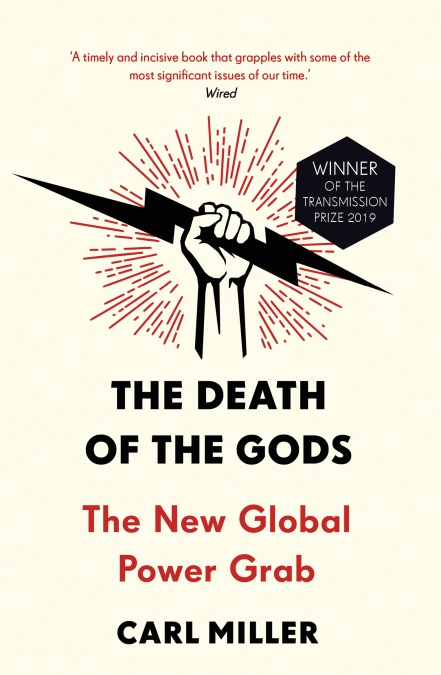 The world is changing, no doubt. Would you like to know how some of the elements of our contemporary world are evolving? I would encourage you to read The Death of the Gods by Carl Miller to find out more about these changes. Carl Miller demonstrates how some of the elements of our contemporary world are shifting, and this book traces a historically embedded sequence of changes in power, including its latest phase.
More specifically, after the Cambridge Analytica scandal, public opinion pays more attention to how Internet activity is affecting our daily and political realities. Both sociologists and the public should be getting more attuned to what is going on in that space. Thus, one way of doing that is by reading Carl Miller's The Death of the Gods. Cyberattacks during election times might affect a political landscape, so it would be good for social scientists to understand more how critical these issues are to democracies. This book is a timely reminder of how some of the changes in the power structure affect all of us, even though most examples and situations discussed in this book relate to the developed countries.
The Death of the Gods highlights how centres of power are shifting in contemporary societies of the Global North (and no doubt South too), with emphasis on the unparalleled speed and pace of change. The book is aimed mostly at non-academic audiences, but it offers some basic theoretical grounding about debates on power. It aims to show how some old "gods" (a direct reference to Greek mythology) are losing their power and how new ones are emerging in the early twenty-first century. This book discusses the association between power and modern technology (i.e. computers, all types of computer software, and mobile phones).
This book is relevant and has broad scope. It sits at the intersection of discussions on power, crime, and how technology influences contemporary globalised societies. It fits into public debates on the role of the internet, social media, and “post-truth” in shaping contemporary communication, culture, and politics. It describes a shift from power based on means of production towards power based on means of mediation (for example, the ownership of software and devices using that software).
Carl Miller begins his book by introducing basic information on the discourse on power. He examines how power was perceived from a traditional geopolitical point of view. Miller mentions some of the most influential authors in that academic space (i.e. sociology and philosophy, for example, Niccolò Machiavelli, Thomas Hobbes, Karl Marx, Hannah Arendt, Michel Foucault, and Robert Dahl) and some of their approaches. He taps into a growing tendency amongst journalists, academics, and influencers assuming a societal transition or revolution within a contemporary globalised world induced by technological change. More detailed historical context is provided in specific chapters. One emerging theme of the book is that most shifts in power have their roots in social, political, and cultural changes (e.g. means of communication or technological advancement) occurred during the 18th, 19th, and 20th centuries.
For Carl Miller, all forms of technologies are instruments of social control; for instance, certain social media platforms can influence social norms and pressure people to conform to these reformulated norms. Similarly, these technologies affect how power can be gained and lost. The association between modern technology (based on digital means of communication) and power is not a new one as it is present in the public sphere from at least the 1980's. Miller shows how information is transferred into power, and how, for example, hacking became a new route to power. Thus, he claims that hackers—a multiform social group—are “a strange new kind of ruling class” (p. 21). Hackers are defined by their skills, knowledge, mind-set, and curiosity as to how the technology works.
Hacking is all about knowing how specific elements of our contemporary reality operate and interact, and about being able to exploit its imperfections and vulnerabilities to one’s advantage. In Miller’s own words: “[t]he device isn’t doing what the maker designed it to do. It’s doing what you wanted it to do. You, through a mixture of knowledge, skill, perseverance—you’ve owned the device! You have reached out and changed the world” (p. 23). Thus, hacking is one of the defining skills shaping the contemporary public sphere. Hackers can influence power relations which depend on technology by exploiting vulnerabilities of that technology (for example, to blackmail someone over their illegally obtained private correspondence or pictures).
Similarly, this book demonstrates how governments can be ridiculed, undermined, or even overthrown using social media and connectedness. Considering that, whoever mastered control over computers, mobile devices, or relevant software can create favourable conditions for themselves to control a portion of a public sphere which is reliant on that hardware and software. In the context of traditional institutions and centres of power, Miller notes that “... the technology weakens the very structures and institutions that determine where power sits, they weaken the rules for how power can be legitimately used” (p.333).
The main weakness of the book is that some arguments are scattered across chapters, or else, the discussed arguments are not following the central themes of specific chapters. The most vivid example of that is a chapter on warfare. This section focuses predominantly on the use of information in modern warfare, and the military element of that chapter is somewhat in the background. Armies depend on information; nonetheless, the focus of this section of the book seems to be fluctuating between warfare and attention-hacking or fact-checking. Such fluctuation influences the strength of the presented arguments.
Miller claims that his book is a ground-breaking examination of the new centres of contemporary power and control. Indeed, his book challenges the prevailing assumptions about the centres of contemporary power by providing examples of entities which gained or lost power in recent times, such as such as, the Big Four (Google, Amazon, Facebook, Apple) or governments. This book brings to light multiple facets of power. It is a story about liberation and control, and how the new communication channels are changing the composition of power structures. Also, The Death of the Gods is a story about the weakening of the old hierarchies (e.g. elite political parties, business leaders, and those who controlled other traditional centres of power). Miller observed that in the United States older and newer forms of power feeds off one another, for example, when the tech giants (the new power) finance politics and politicians (the old power).
The book’s content was enhanced and contextualised by personal experience acquired in the process of meeting with, and interviewing, people who thanks to their expertise and experience on power and dominance significantly enriched the author’s understanding of discussed matters. It uses some of the most current examples (relating to fake news or information warfare) which may prove especially useful for lecturers wishing to include an accessible reading about the effects of technology on the political, social, and cultural spheres of life. Overall, The Death of the Gods offers a fresh and broad perspective on the new and emerging form of power that is coming to distinguish twenty-first-century liberal democracies.
Blazej Kaucz has just obtained his PhD in Criminology from UCC on the topic of Militarisation of Behaviours: An Investigation into the Development of the 20th Century Polish Criminal Law Through Lenses of Legal Textbooks. He has an LLB and LLM from Wroclaw University in Poland.
